Thursday, September 30, 2004

I coulda told them THAT!

Is Caffeine Withdrawal a Mental Disorder?
Er. YES.
1 in 8 People Can't Function Without Daily Fix
That's ALL??
Sept. 30, 2004 -- Researchers are saying that caffeine withdrawal should now be classified as a psychiatric disorder.

A new study that analyzes some 170 years' worth of research concludes that caffeine withdrawal is very real -- producing enough physical symptoms and a disruption in daily life to classify it as a psychiatric disorder. Researchers are suggesting that caffeine withdrawal should be included in the next edition of the Diagnostic and Statistical Manual of Mental Disorders (DSM), considered the bible of mental disorders.

"I don't think this means anyone should be worried," says study researcher Roland Griffiths, PhD, professor of psychiatry and neuroscience at Johns Hopkins School of Medicine. "What it means is that the phenomenon of caffeine withdrawal is real and that when people don't get their usual dose, they can suffer a range of withdrawal symptoms."

I'm so glad someone got paid to study 170 years of information on this. Hell, anyone caffeine addict will be glad to tell you exactly what it's like to go cold turkey, and it ain't pretty.
Sheesh.

Next, they'll say eating chocolate and ice cream helps alleviate symptoms of depression and PMS.

Sunday, September 26, 2004

Oh, I got another book coming out this year

Just in case you are one of the few readers of the blog who also reads my porn, my "best of" collection, The Catalyst and Other Works, will be out before the end of the year, and some kind folks are already taking preorders. Drop me a note if you want the secret code to get 10% off the cover price.

Wednesday, May 19, 2004

101 Top books?

101 Great books recommended for high school students, especially those heading on to college. Frankly...I don't see todays high schoolers having the ability to read many of the books on this list. The ones in bold are ones I've read.

-- Beowulf
Achebe, Chinua Things Fall Apart
Agee, James A Death in the Family
Austin, Jane Pride and Prejudice
Baldwin, James Go Tell It on the Mountain
Beckett, Samuel Waiting for Godot
Bellow, Saul The Adventures of Augie March
Bronte, Charlotte Jane Eyre
Bronte, Emily Wuthering Heights
Camus, Albert The Stranger
Cather, Willa Death Comes for the Archbishop
Cervantes, Miguel de Don Quixote
Chaucer, Geoffrey The Canterbury Tales
Chekhov, Anton The Cherry Orchard
Chopin, Kate The Awakening
Conrad, Joseph Heart of Darkness
Cooper, James Fenimore The Last of the Mohicans
Crane, Stephen The Red Badge of Courage
Dante Inferno
Defoe, Daniel Robinson Crusoe
Dickens, Charles A Tale of Two Cities
Dostoyevsky, Fyodor Crime and Punishment
Douglass, Frederick Narrative of the Life of Frederick Douglass
Dreiser, Theodore An American Tragedy
Dumas, Alexandre The Three Musketeers
Eliot, George The Mill on the Floss
Ellison, Ralph Invisible Man
Emerson, Ralph Waldo Selected Essays
Faulkner, William As I Lay Dying
Faulkner, William The Sound and the Fury
Fielding, Henry Tom Jones
Fitzgerald, F. Scott The Great Gatsby
Flaubert, Gustave Madame Bovary
Ford, Ford Madox The Good Soldier
Goethe, Johann Wolfgang von Faust
Golding, William Lord of the Flies
Hardy, Thomas Tess of the d'Urbervilles
Hawthorne, Nathaniel The Scarlet Letter
Heller, Joseph Catch 22
Hemingway, Ernest A Farewell to Arms
Homer The Iliad
Homer The Odyssey
Hugo, Victor The Hunchback of Notre Dame
Hurston, Zora Neale Their Eyes Were Watching God
Huxley, Aldous Brave New World
Ibsen, Henrik A Doll's House
James, Henry The Portrait of a Lady
James, Henry The Turn of the Screw
Joyce, James A Portrait of the Artist as a Young Man
Kafka, Franz The Metamorphosis
Kingston, Maxine Hong The Woman Warrior
Lee, Harper To Kill a Mockingbird
Lewis, Sinclair Babbitt
London, Jack The Call of the Wild
Mann, Thomas The Magic Mountain
Marquez, Gabriel Garcia One Hundred Years of Solitude
Melville, Herman Bartleby the Scrivener
Melville, Herman Moby Dick
Miller, Arthur The Crucible
Morrison, Toni Beloved
O'Connor, Flannery A Good Man is Hard to Find
O'Neill, Eugene Long Day's Journey into Night
Orwell, George Animal Farm
Pasternak, Boris Doctor Zhivago
Plath, Sylvia The Bell Jar
Poe, Edgar Allen Selected Tales
Proust, Marcel Swann's Way
Pynchon, Thomas The Crying of Lot 49
Remarque, Erich Maria All Quiet on the Western Front
Rostand, Edmond Cyrano de Bergerac
Roth, Henry Call It Sleep
Salinger, J.D. The Catcher in the Rye
Shakespeare, William Hamlet
Shakespeare, William Macbeth
Shakespeare, William A Midsummer Night's Dream
Shakespeare, William Romeo and Juliet
Shaw, George Bernard Pygmalion
Shelley, Mary Frankenstein
Silko, Leslie Marmon Ceremony
Solzhenitsyn, Alexander One Day in the Life of Ivan Denisovich
Sophocles Antigone
Sophocles Oedipus Rex
Steinbeck, John The Grapes of Wrath
Stevenson, Robert Louis Treasure Island
Stowe, Harriet Beecher Uncle Tom's Cabin
Swift, Jonathan Gulliver's Travels
Thackeray, William Vanity Fair
Thoreau, Henry David Walden
Tolstoy, Leo War and Peace
Turgenev, Ivan Fathers and Sons
Twain, Mark The Adventures of Huckleberry Finn
Voltaire Candide
Vonnegut, Kurt Jr. Slaughterhouse-Five
Walker, Alice The Color Purple
Warton, Edith The House of Mirth
Welty, Eudora Collected Stories
Whitman, Walt Leaves of Grass
Wilde, Oscar The Picture of Dorian Gray
Williams, Tennessee The Glass Menagerie
Woolf, Virginia To the Lighthouse
Wright, Richard Native Son

Friday, December 05, 2003

Because the name "Biggus Dickus" was taken?

Fossilised crustacean boasts oldest penis A newly discovered 425 million-year-old fossil boasts a lurid claim to fame - it has the oldest penis on record.

The five millimetre long crustacean, discovered by UK and US researchers, has been named Colymbosathon ecplecticos - derived from the Greek for "astounding swimmer with a large penis".

The well-endowed creature is surprisingly similar to modern relatives, despite being entombed nearly half a billion years ago, says the team.

David Siveter, a paleontologist at the University of Leicester, and colleagues unearthed the clamlike species in a rock formation in Herefordshire, UK. The creature possesses a hard shell, an organ for grabbing prey, six gills, as well as a "copulatory organ [that] is large and stout", says the team....

From Monty Python's Life of Brian:

BRIAN
I'm not Jewish ... I'm a Roman!
PILATE
*WOMAN*?
BRIAN
No, *ROMAN*.
(But he's not quick enough to avoid another blow from the CENTURION.)
PILATE
So, your father was a *WOMAN*. Who was he?
BRIAN (proudly)
He was a centurion in the Jerusalem Garrison.
PILATE
Oh. What was his name?
BRIAN
Nortius Maximus.
(An involuntary titter arises from the CENTURION.)
PILATE
Centuwion, do we have anyone of that name in the gawwison?
CENTURION
Well ... no sir.
PILATE
You sound vewwy sure ... have you checked?
CENTURION
Well ... no sir ... I think it's a joke, sir ... like ... Sillius Soddus
or ... Biggus Dickus.
PILATE
What's so funny about Biggus Dickus?
CENTURION
Well ... it's a ... joke name, sir.
PILATE
I have a vewwy gweat fwend in Wome called Biggus Dickus.
(Involuntary laughter from a nearby GUARD surprises PILATE.)
PILATE
Silence! What is all this insolence? You will find yourself in
gladiator school vewwy quickly with wotten behaviour like that.
(The GUARD tries to stop giggling. PILATE turns away from him. He is angry.)
BRIAN
Can I go now sir ...
(The CENTURION strikes him.)
PILATE
Wait till Biggus hears of this!
(The GUARD immediately breaks up again. PILATE turns on him.)
PILATE
Wight! Centuwion ... take him away.
CENTURION
Oh sir, he only ...
PILATE
I want him fighting wabid wild animals within a week.
CENTURION
Yes, sir.
(He starts to drag out the wretched GUARD. BRIAN notices that little
attention is being paid to him.)
PILATE
I will not have my fwends widiculed by the common soldiewy.
(He walks slowly towards the other GUARDS.)
PILATE
Now ... anyone else feel like a little giggle when I mention my fwend ...
(He goes right up to one of the GUARDS.)
Biggus ... Dickus. He has a wife you know.
(The GUARDS tense up.)
Called Incontinentia.
(The GUARDS relax.)
Incontinentia Buttocks!

Wednesday, November 19, 2003

Hey, kids, take this fun quiz!

Can you tell the difference between arguements against interracial marriage and same-gender marriage? Give this handy-dandy test a try!

Same Race, or Same Sex?

Thursday, May 29, 2003

Ah, a writer's life

Yes, I write smutty books. People often ask me if that's a good way to make money. Go take a look at what the Insta-Industry gets in royalties and tell me what you think.

Friday, April 18, 2003

Passover haiku

I know, I know, I need to go shopping and start cooking for our seder tomorrow night. But I can't resist Passover Haiku.

Left the door open
for the Prophet Elijah.
Now our cat is gone.

Lacking fins or tail
the gefilte fish swims with
great difficulty.

Friday, April 11, 2003

Amazing coolness

Ever wonder how big the Millenium Falcon is compared to, say, the Vorlon Planet Killer, as opposed to the Enterprise?

Go here! But only if you have high speed access.

Wednesday, February 26, 2003

Star Trekin' across the universe...

Mark Simpson over at Salon has a very funny and pointed article on Star Trek. It opens:
The first thing that greets me is Capt. Kirk's package. Jim's intergalactic manhood is clearly, alarmingly outlined against the fabric of his tight 1960s-cut black trousers, dressing very much to the left. I assure you I wasn't looking for it -- it just loomed up like a de-cloaked Romulan Bird of Prey. It shouldn't be surprising that James Tiberius Kirk, the famously gung-ho Starfleet commander, went commando, boldly swinging where no man had swung before. Maybe that, as much as his twinkly mascara'd eyes and his captaincy of the fastest, flashiest vehicle in the galaxy, the USS Enterprise, was the secret of caddish Jim's phenomenal success with lady humanoids and aliens alike.
Read the rest of this hilarious piece here.

Tuesday, February 25, 2003

She writes fiction, too

I'd read several modern romance-style books by Naomi Ragen before I discovered she was an editorialist as well. I hear her voice perfectly well in Peace, Peace, but there is no Peace

Thursday, February 20, 2003

The Queens folklorist

The borough I live in has it's own folklorist! Very cool.

Friday, February 07, 2003

File this under, "Only in New York"

With hospital, you get eggroll; and it's kosher!

(updated December 2008) leave it to my wife, Karen, to tell me that there's actually a book out about this hospital *sighs* I guess that's her way of hinting at a Hanukkah gift.

Did I mention that she has odd taste in books?

Tuesday, December 24, 2002

On an even LIGHTER note...

sigh
As promised, here's me, on the Dead Sea.

02_13_0098.jpg

On a lighter note

This is where we ended up having dinner. Mmmm! Five different kinds of salads, cold Carlsberg beer, hot, freshly baked pita right out of a stone oven, steaming chick peas nestled in virgin olive oil on hummus, and then skewers of roasted beef and lamb. Hot tea with fresh sprigs of mint floating in it, and two tiny sweets, and great company. This is where the locals eat, assured our friend Tuvia.

Karen writes about Yad Vashem

We did go to Yad Vashem. It's not easy to describe. Approaching it from another perspective first: the museums we've visited in Israel are designed very differently than those in the U.S. The "one large building" with or without a garden with sculpture or benches is not really the standard look here. Certainly, the museums are large buildings. But they are more often, connected buildings that have open passageways connecting them, which continually keep the visitor experiencing the outside. The Israel Museum, for instance, brings you through a large visitor center/coat room/gift shop/cafeteria space, and then you leave that building in order to go "to the museum." By doing this, you cross through an open landscaped space filled with both modern and contemporary sculpture, and pieces of ancient mosaics. After about 100 yards of walking, you come upon another building, which is actually three interconnected buildings that have entrances on three different levels (Jerusalem being mountainous, it depends where along the open space you choose to enter the building). The Dead Sea Scrolls and their space was described earlier.

The Bible-Lands Museum (which is much, much better than this hokey name implies) is similar -- a large space, built in a vaguely ziggurat style, but still, there are places where you find yourself walking through an open door into a separate building, with the sky above you.

(a brief digression: the Bible-Lands Museum is well worth the visit for anyone interested in the development of civilization in this part of the world. The exhibits are beautifully laid out, and the overlay of pieces of scripture unexpectedly enhance the presentation: "Rebekah went to the well" is inscribed over a series of ancient pitchers and you suddenly realize -- it's THESE pitchers Rebekah would have carried. Ah.)

The archeological museums we visited in Zippori, Jerusalem, Jaffa, and Ceasarea are even more intriguing. For instance, in Jaffa and Jerusalem, we weren't really in a museum. We were in a cleaned-up archealogical dig that exposed a series of ancient Roman houses and streets, with a roof covering the entire area. The exhibited artifacts had never been moved from their original site -- the museum is literally built around them, the foundation stones bursting out of the floor path that has been put in for us to follow.

And then, Yad Vashem.

Similar in construction to these other Israel museums in that there are several buildings, each surrounded by greenery, trees, pathways. This is more than architecturally beautiful -- it is necessary to the visitor. We first visit a large one-story building. It is dark inside, except for a perpetual flame flickering. As our eyes get used to the darkness, we see that we are standing before a floor in which is inscribed the names of the camps where Jews were murdered. We learn that under the floor is the recovered ashes from the ovens, so that these victims can be buried here in Israel. I say kaddish, my throat already constricting with the difficulty of the experience.

And that is the first place. We leave, returning to sunlight, and a wide expanse, a stunning view of the hills of Jerusalem. The trees planted all around us each have a plaque - they are planted in memory of the Righteous Gentiles, those who helped in any way they could to save the Jews. There are hundreds of trees.

We move into the second building. This is the historical building, two or three stories that begin with the history of anti-semitism, and then the rise of Nazi-ism and modern anti-semitism. It is a static exhibit, in one way (my American eyes are used to the US Holocaust Museum, with its video screens embedded next to posters and photographs), but that's more than enough for me. It is still a brutal exhibit of a brutal history.

We are with a small number of English speakers being led through by a guide. I feel briefly sorry for the Americans with us who are shocked to learn that Roosevelt chose not to increase the Jewish immigration numbers during the war. Our guide is describing bomb raids on factories adjacent to the camps, and prisoners desperately screaming, pleading, writing to the American forces begging to have the camp bombed. We see the letters that inform Roosevelt exactly what the purpose of the camps are, and we see the official American response to refrain from bombing them. One woman in our group quaveringly asks "why didn't Roosevelt stop them?" And the guide turning unblinking sabra eyes to her to say "because they were Jews. And no one wanted the Jews." The documents next to the photographs clearly state this. It is terrible to see, but I am at least better informed about this part of American history than the woman beside me, who is nearly unable to continue to the tour because of her shock.

The Hall of Names. I don't know what I expected to see when we followed that sign. Perhaps an artistic rendering, similar to that in the US Holocaust Museum, of inscribed names on cut glass, names of the Righteous. But no, at Yad Vashem, the Hall of Names is a hall of card catalogues. It's the size of the main card catalogue room in the Israel National Library. The card catalogues cannot be approached, but there are copies of some of the documents that are kept in them, and we look at those. They are 5x7 index cards with photographs. Names. Last known residence. Camp, if known. And a verification signature of someone still living, a relative who traveled to Yad Vashem to find their sister, uncle, grandparent's name, and confirm that yes, they were part of the Jewish people, and should be remembered here. I see signatures from 1987, from residents in Brooklyn, Philadelphia, London, Moscow, who visited this place in order to make sure their relative is recorded at Yad Vashem.

This museum also has art, sculptures and paintings that comprise the largest collection of Holocaust art in the world. It also houses a collection of art previously owned by Jews -- art that was stolen by the Nazis, and later recovered. Of course, many of the owners were murdered. At a recent auction at Christie's, a well known Jewish philanthropist, Ron Lauder, purchased a huge collection of this recovered art, and donated it to Yad Vashem. Some of the art is Jewish, some not -- but its presence in the museum is very appropriate. This is what Jews had in their houses. These are paintings that someone used to own who should have been able to pass it on to their children. So now it's here.

We leave that building, and burst into another large open space. Now I truly understand the need for these spaces. The buildings are beautifully constructed, but what they contain can crush you. We need to breathe. We see a large landscaped construction and head toward it, to find out that it is a monument to those Jewish soldiers who fought and died on the Allied side. We head back through the trees, via the Avenue of the Righteous, and past some of the stunning and famous Holocaust sculptures that are stark against the grey skies.

On our return toward the beginning of this vast campus, we visit the Children's Museum. I cannot describe it adequately. The space is dark, with yarhzeit candles burning through walls and mirrors, until we find ourselves in a dark space punctuated by flickering flames. In one area are faces of children projected onto an invisible wall, but mostly it's candles. And voices. Naming children. Their ages. Three. Seven. Nine. Where they are from. It is a profoundly moving place.

Before I finish this message, I must ask you to think about these spaces now, filled with soldiers. Because it turns out that the Israel Defense Forces are required to visit Yad Vashem as part of their training. The officers are required to lead their units through, acting as tour guides. Everywhere we go, olive uniforms and M-16's surround us. Young faces, but hundreds of them, moving in groups of 20 or so. We are first afraid to push ourselves past these guns (wouldn't you be?), but after watching our tour guide do so, we realize that it's not a problem. The soldiers move aside as we travel through the closed spaces, the open spaces. We pass groups of them on the lawns, standing in large circles, listening to their officers. We are nearly crushed by them as they move into new exhibit spaces, staring at the posters that read "Death to Jews" in all of the modern European languages. Together, we look at the photographs of the leader of the Mosque in Jerusalem meeting with Hitler, shaking hands and agreeing that they have a common enemy. That strikes close to home for these soldiers.

When I first visited the Holocaust Museum in Washington, DC, it was during the 1993 March on Washington. The Museum had opened just that month, and thousands of gay men and lesbians were standing in line to visit the space. Together, we traveled through that incredible space, Jews and queers, sometimes together, sometimes even comforting each other. Outside, on the mall, was the AIDS quilt. Our communities know far too much about devastating death and lack of government response. The collective pain was palpable that day.

At Yad Vashem, the pain is not just palpable, it is still alive. I felt that even more, surrounded by soldiers. This place is here so that these young people can see one of the most important reasons why they are in uniform, why they must be called to fight. It is a terrible thing, and yet... what monuments do we have in the US that are REQUIRED as part of our military's education?

Because it is, after all, Christmas Eve

Santa Claus - with an Armenian twist - has come into the internet cafe and is distributing candy to all the kids here. The Little Drummer Boy is playing in Arabic. The kids are cramming chocolate in their mouths and ringing little bells and cheerfully wishing everyone a Merry Christmas in at least three different languages. It's a sort of glorious chaos, and I am glad we came one last time. The sun is setting and soon the stores will close down. If Christians are coming to the Old City, they should be coming in now.

I understand that the people in Bethlehem, in protest of the Israeli security measures taking place around that city, are not decorating their city this year, but celebrating in purely religious ways. More power to them, I say. Take the decorations out of Christmas and keep it religious, a festival of faith and personal joy. When I woke up this morning, I said, in wonder, to Karen, "For the first time in my life, this isn't Christmas Eve. It's Tuesday." Part of that is my growing comfort with the Jewish calendar. But a bigger part, I think, is the fact that here, Christmas *is* a religious holiday. (Except to some Russians, LOL) There are no garish displays in store windows, at least none that I've seen. No "Xmas Sales!!" No countdown of shopping days.

So, to those celebrating in Bethlehem tonight, may the loss of lights and glass balls and garlands be completely unnoticeable. May they be warmer than we are right now in Jerusalem, and may the wind not blow their candles out. And may they be grateful to be able to celebrate Christmas in a land where Christians are the minority. Plenty of Christians in other lands tonight, from China to, oh, our allied countries like Saudi Arabia, will be celebrating quietly at home, and hoping for the day when they can gather in public and not be afraid.

Where we were in Jerusalem

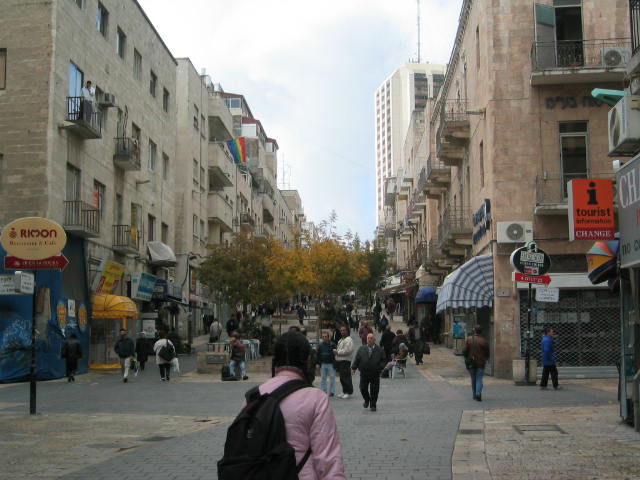
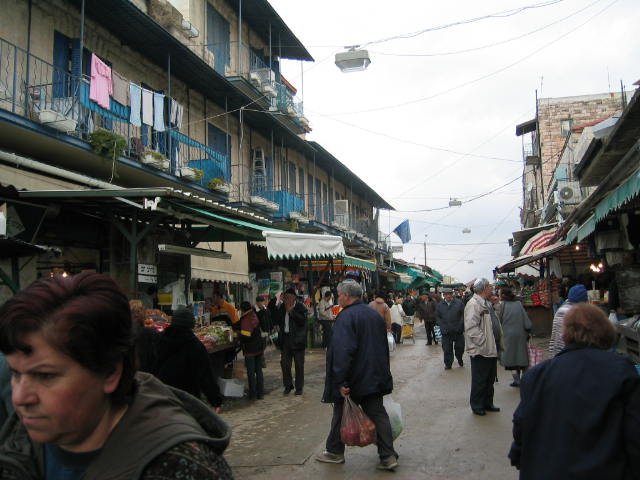
Here are three shots taken in the neighborhood we stayed in. The first is looking down the pedestrian mall of Ben Yehuda street, Can you spot the rainbow flag? That's where the Jerusalem Open House is, the local gay organization where we found great hospitality. The second picture is of one of the famous Irish stores you can find here in Israel. Yes - get your tallis on sale at Danny Boy's place. Half off on all Hanukkah items. The third picture is of a huge open air market a few blocks away from our hotel which would make any chef cry for the quality of the produce.

BenYehuda1.JPG

DannyBoy.JPG

MEN_YEHUDA1.JPG

The sounds of Jerusalem

Sting, moaning about "How Fragile We Are."
Besame Mucho, played on an instrumental tape in a cab
The rapid ticking at the corner of Ben Yehuda and King George when the light turns green and it's safe to cross
"Jingle Bells" in Arabic
The Israeli pop music mixed with American stuff coming out of the trendy clothing shops on Jaffa Road
The crunch of walking through another street under construction
"I have here wonderful guide, wonderful shop, no need to buy, just look..."
Jerusalem, City of Gold, played on a balalaika by a street musician
Store and car alarms that go off making everyone stop for a second, look for the source and continue as usual
"Are you Jewish? Have you ever done this? Come, let us show you how!"
The buzz of radios clipped to shoulders of police and soldiers
"We we gathering stars while a million guitars played our love song..." in a cab
Celine Dion and Julio Iglascias
The call to prayer; the many calls to many prayers, voices and bells and men looking for a tenth man to bless the new month
"America? New York? I have a cousin in New York!"
Horns, and the shaky sound of 4 cylinder engines that need tune ups.
"L'chiam!"
"Come back again...and bring your friends!"

Karen talks shopping

Remember the earlier entry Laurie did about visiting a shop that was owned by the brother of another shopkeeper and was business partners with the son of another shopkeeper we also visited?

Well, what she didn't mention was the nearly two hours we spent in the shop bargaining. This was AFTER the hour or so we spent actually deciding on the things we were going to buy. It was pretty amazing to see this side of her -- and moreover, how naturally she fell into it!

I'm sure most of you know that bargaining is a time-honored (as in thousands of years) tradition in the Middle East. It is an expected part of the marketplace experience. And most of you also know that Americans are notoriously bad at bargaining in these environments. We tend to do one of two things: first, we feel guilty that we're so wealthy compared to these guys and only cover one round or so of bargaining before agreeing to a price, knowing that we would still be paying more in our own country for the same merchandise. Or, we bargain badly, by whining, complaining, denouncing the quality of the stock, or insulting the shopkeeper. By the end of the transaction, we still end up paying more, and worse, we've confirmed the Ugly American stereotype.

Laurie does neither of these. We start to gather items together. The shopkeeper follows her, giving a running commentary on quality, quantity, and history of every item she looks at. Laurie listens patiently, and then announces "no, I'm not going to pay that price." He argues, she smiles, and replaces the item. He picks it up, offering a lower price. Laurie shakes her head, attention turned elsewhere. This leaves the shopkeeper in a dilemma - does he continue to offer a lower price on the original item, or follow her to the new location and begin discussing the merits of that item?

Periodically, he turns his attention to me. I'm obviously the easier target -- me with my midwestern face and carrying a purse. I smile, and tell him that I don't buy anything without Laurie. He grimaces and says "your friend -- she's tough. Nice, but tough."

And you know, Laurie IS nice. She is firm in her refusals, and equally firm in her determination about what she is not willing to pay. She never denounces the quality, but if she questions quality, she does so by asking the shopkeeper if he has something "similar, but nicer." She is praised for her keen eye.

Finally, Laurie has compiled a pile of items, and we are only actively looking at one or two other things. At this point, we are offered beverages -- tea, coffee, coca-cola. We accept. Because now, the serious bargaining begins. This is where Laurie shines. Me, I would have assumed we already did the bargaining part -- where each item has been identified as being of interest, and a price put to it. But not Laurie.

"What price are you offering for all of this?" she says, pointing her hand to our pile of jewelry, blankets, purses, Roman coins, and the like. The shopkeeper offers a price, plus reduced shipping to the U.S. Laurie shakes her head and says "too much." She moves one item out of the pile. The shopkeeper immediately returns the item to the pile, and suggests another price. "No, still too much. I think I can do without this," she says, pushing the item out of the pile again. The shopkeeper argues with her. How can she leave his shop without such a beautiful piece? One of a kind! Unique! Hand-crafted! Found only in remote locations of the Negev, brought in on camels. "It's not to my taste," she says. Now, the price is reduced on that item, by about 30%.

But still, Laurie persists. "How much NOW for all of this?" she asks. The shopkeeper goes through the list again, reminding her where he has offered earlier discounts, suggesting that he has been terribly kind in the new 30% discount, and then offering perhaps, free shipping of all items to the U.S.

We are now about 1/2 the way through our beverages, and I am intrigued by the body language around me. There are four of us in the shop, Laurie and me, the shopkeeper, and an assistant. The assistant is quietly putting things back in order, periodically catching my eye to hold something he thinks may be of interest. Mostly jewelry, "for beautiful lady." I smile and say I rarely wear jewelry, and have already chosen pieces for my friends and family. He shrugs, smiling, and returns to his task. The shopkeeper bargaining with Laurie is communicating his agony, how we are dragging his blood out by the fingernails. But I also see how relaxed he is, how happy. I know of course that some of this is because he knows we will buy something, and businesses in the Old City are hurting badly from the lack of tourists. He knows this, of course, because our body language is also relaxed. Neither of us look like we're about to bolt out of the shop, give up on this difficult bargaining challenge, and leave in an angry huff. So the shopkeeper can relax. We will buy.

But I suspect he also is relaxed because he has found a worthy shopper in Laurie. She is focused, committed to leaving with the best possible deal. He understands this, and he is giving us the full benefit of his travails. We are an appreciative audience.

By this time, the coca-colas have been empty for 30 minutes. Evening shoppers are ducking their heads in. They see us, hear American accents, and feel safe -- if WE shop here, it must be a place that is safe. But I feel sorry for them. If they buy, they will not have Laurie with them. They will miss out on a significant part of the shopping experience here.

We leave with what would have been another full suitcase of items, but we're getting them shipped, free of charge, instead. And I think we also leave a shopkeeper who must struggle with a dearth of business, punctuated with bouts of poor bargainers. I hope that his evening with us gives him a smile through these dark and economically difficult times in the Old City, just inside Jaffa Gate, at the Petra Shop.